'It ties Trump to the future of Ukraine’: What is the US-Ukraine minerals deal?
| Updated:

A deal has been agreed between Ukraine and the Trump administration for the US to profit from the rare earth minerals in Ukrainian soil. Is this the first step towards lasting peace?
Listen to this article
Read time: 5 minutes
In brief…
- The US and Ukraine have signed a minerals deal creating a 50-50 Reconstruction Investment Fund that gives America access to Ukraine's valuable resources like iron, lithium, and uranium, while specifically avoiding language that frames it as "payback" for previous military aid.
- Ukrainian advisor Yurir Sak views the deal with "cautious optimism" as it recognises Ukraine as an equal partner and includes US Treasury Secretary Bessent's commitment to "a free, sovereign and prosperous Ukraine," though Sak wishes it contained more explicit security guarantees.
- The agreement marks a significant shift in Trump's stance toward Ukraine (following their earlier Oval Office confrontation), with the administration now recognising "Russia's full scale invasion" and approving $50 million in arms exports to Ukraine, though The News Agents remain wary about whether Trump's support will remain consistent.
What’s the story?
Iron, Lithium, Titanium. Uranium. Graphite. Donald Trump has long-wanted access to the highly valuable resources found in Ukraine, and a new deal is set to ensure the US now profits from these in exchange for ongoing support in its war against Russia.
Ukrainian ground is rich in these rare earth minerals – among others – and America's treasury secretary Scott Bessent has described the deal between Ukraine and the US as a step towards "lasting peace" in Ukraine.
"The Trump administration is committed to a peace process centred on a free, sovereign, and prosperous Ukraine over the long term," he added.
Ukraine has been ravaged by war since February 2022, when Russia first launched its illegal invasion. In the 38 months since, hundreds of thousands of people have lost their lives on both sides of the conflict.
The minerals deal is believed to have been secured when Trump met with President Volodymyr Zelensky at the funeral of Pope Francis, with images of the two meeting close to the coffin, in a far calmer conversation than their infamous spat in front of TV cameras in the Oval Office in February 2025.
The deal will establish a 50-50 US-Ukraine Reconstruction Investment Fund, which will allow the US to recoup the estimated $175 billion (£131.37 million) of military aid it has given in the past three years through access to Ukrainian minerals.
The language used in the deal is significant, as it does not refer to the money the US will receive from extracting minerals as “payback” for their military support, it also demonstrates solidarity with Ukraine for the first time since Trump took office, recognising “Russia’s full scale invasion”.
The US deal has been signed by senior Ukrainian politicians, and must be approved by its parliament before it can be implemented.

Is the minerals deal a good deal? And is it the first step towards peace?
Yurir Sak, an advisor to the Ukrainian government, tells The News Agents he has mixed feelings about the minerals deal that’s been signed, but believes Ukranians should be “cautiously optimistic”.
The final version of the deal states that Ukrainian minerals will not be considered as “payback for military and financial support that Ukraine received in the past” – which has been a key concern in previous deals proposed for the deal.
“That has been removed from the wording of the agreement,” Sak says.
“This is fair and just.”
He says the Reconstruction Investment Fund is a “deal between equal partners”.
“Bessent said very clearly in his statement there is a commitment of the United States of America to a free, sovereign and prosperous Ukraine.
“So that's on the record now, and that means that going forward, nobody will expect Ukraine to give up on our territorial sovereignty, which is the only way to achieve just peace”.
Despite this optimism, Sak says the deal wasn’t perfect.
“We wish there were more clearly stipulated security guarantees in this deal… It’s implicit, rather than explicit,” he adds.
“We have to view this agreement today as part of a wider framework within which security guarantees will be provided, not necessarily by the US, but maybe by our European partners.”
That doesn’t mean that the US won’t provide more security for Ukraine - Sak’s says there are “early, unconfirmed signs that the military support will be forthcoming”.
Those early signs are already showing, with the Trump administration giving the green-light for roughly $50 million in arms exports to Ukraine, the Kyiv Post reports.
“What we're seeing now is being played out, is the second act of the deal,” Saks says.
“I think somewhere in that book it says that once the first strategy is not working, then you have to apply pressure on the bad guys.”
That pressure could come in the form of Trump’s favourite word - tariffs. Reports suggest that a bill has been proposed to the US congress to impose 500% tariffs on countries who buy oil from Russia.”
“That will cripple the Russian economy,” Saks says.
“The fact that we have signed the critical minerals deal is a sign that the US is still our strategic partner, and it sends a very good and strong signal to Russia.”
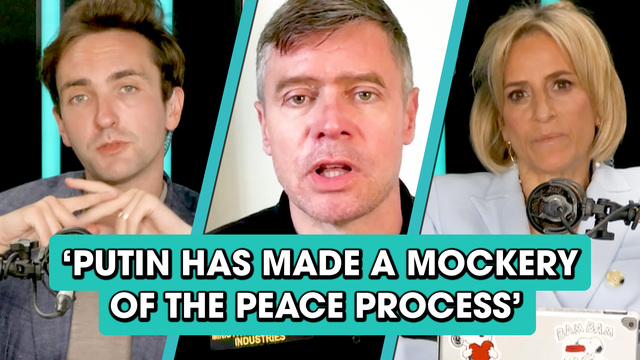
'Putin has made a mockery of the peace process'
What’s The News Agents’ take?
Lewis Goodall says the signing of the minerals deal is “a major moment in the history of the Trump administration, which has been so hostile to Zelensky and Ukraine itself.”
Donald Trump recognising Russia’s full scale invasion of Ukraine in 2022 has been a stumbling block for Trump and Zelensky - with the President of the US previously stating that the Ukrainian leader started the war and was a “dictator”.
“It seems almost absurd that we could be focusing on something that seems utterly transparent to the rest of the world,” Emily Maitlis says.
But we are - and US Treasury Secretary Bessen’s line that the American people hope to invest with Ukraine – in a free, sovereign and secure Ukraine – is a significant change.
“The feeling around this is, is there enough of a sense of literal investment, but also a confidence investment by America in Ukraine that will put Putin off task?” Emily asks.
Lewis says that although there is no explicit mention in the text about a security guarantee, which is something Ukrainians had long desired, Bessent using those words seems “completely impossible” mere months ago after the infamous Oval Office meeting between the two leaders.
“It is tying Trump to the future of Ukraine - not just saying ‘we're going to take these resources to get our money back’, but saying that we are committed to the future of Ukraine as an independent nation.
“There have not been that many good days for Ukraine since Trump took office on January 20th - but it does feel as if this has been one of the few.”
The rephrasing of the deal, along with the $50 million arms exports to Ukraine, makes Emily want to “stop the clock here”.
“We want to believe that this is the start of the good news,” she says.
“We all want to be optimistic about this, but you have to couple that with the fact that everything Trump says then kind of unravels about 48 hours later.
“72 – if it's a good week.”
Listen to the latest episode of The News Agents.