'Brutal and Efficient': How Carney faced Trump and won Canada
| Updated:

Mark Carney has won the Canadian election for the Liberal Party on a strong anti-Trump message. Is this the beginning of major pushback against the US president?
Listen to this article
Read time: 5 mins
In brief…
- Carney has spoken against Trump’s intentions to force Canada to become America’s 51st state in a speech after election results were confirmed.
- The News Agents say Carney has “re-energised” Canada and its sense of identity, and believe Justin Trudeau’s total absence from the election campaign one of the reasons it has claimed victory.
- They also question whether Canada’s tough stance on the US, and Trump, could influence how the UK and Starmer deal with America in the future.
What’s the story?
"President Trump is trying to break us so that America can own us - that will never ever happen".
Those were the words of Mark Carney, the newly re-elected Prime Minister of Canada, as he addressed supporters after winning the general election for the country's Liberal Party. It signalled a huge shift in Canadian politics, as well as the first major sign of a pushback to the bully-boy tactics of Donald Trump.
Carney's success has been largely attributed to the actions of Trump, and his unpopularity in Canada. He has hit the country with a 25% tariff on all exports, and stated his intention to make it America's 51st state – neither of which has gone down well with its population. Voters recently told The News Agents in Toronto that they were voting tactically for Carney in a bid to protect Canada's independence and existence.
Just three months ago, under Justin Trudeau's leadership, the Liberals trailed Canada's Conservative Party in the polls, but its popularity – and that of its leader Pierre Poilievre – declined due to its support for Trump, as his aggressive rhetoric and actions against its neighbour increased.
Poilievre said "hard lessons were learned" by his party after the results were confirmed. With votes still being counted, it is too early to currently know whether Carney will secure enough votes to form a majority government, or will need to enter coalition with a rival.
Trump is yet to comment on the election result, but is unlikely to approve of the public criticism from Carney and the election of a leader set to stand against his designs on Canada.
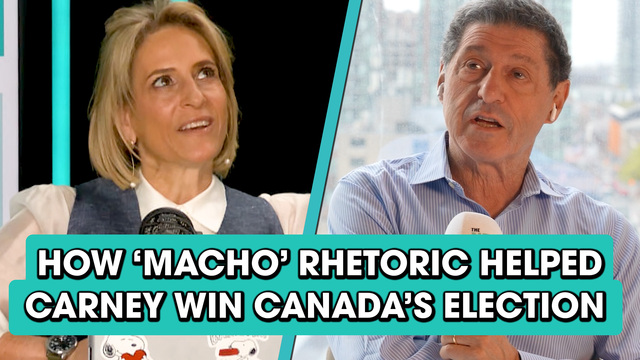
How 'macho' rhetoric helped Mark Carney win Canada's election
How the Liberal Party won the election
At the start of 2025, polls were so far in favour of Poilievre and the Conservative Party, Jon Sopel says he was already picking out curtains for the prime ministerial residence.
Instead, not only did Poilievre lose the election, he even lost his seat.
"That must really hurt," Jon says.
"And by God there was tactical voting. It was either going to be Poilievre as the next prime minister, or it was going to be Carney, and following Donald Trump's intervention, Canadians said: ‘It's Mark Carney’."
Carney, Jon adds, won by simply "standing up to Donald Trump, by refusing to be bullied, by taking the fight to him."
Emily Maitlis says Carney didn't just win the election – he lit a fire beneath the entire country.
"He has re-energised Canada and Canadian nationalism and how it sees itself, but has also sent signals across the Atlantic to where we are, and what Carney's approach to Trump will be," Enily says.
"Is it something that we might try and emulate here?"
But it wasn't only Canadian nationalism that was re-energised by the result of the election, it was the country's two-party political system, with 84% of the vote split between the Liberal and Conservative parties.
There is one other figure in the Canadian results The News Agents say had a hand in the Liberals' victory – even though it was someone notable for their absence: Justin Trudeau.
"When Trudeau left in January, he could have passed all his baggage on to Carney, but he didn't," says Emily.
"Everything went with him; the whole idea of woke, of liberal, of whether he'd actually taken Canada backwards, pushed up inflation – all that stuff stuck to Trudeau.
"When Carney came in, he was actually seen as this banker figure, so I think people trusted him with the economics – they saw him as a new face."
She describes his standing down as "brilliant timing" for the party.
Jon says Trudeau's absence from the campaign effortlessly stole any opportunity for the Conservative Party to use him as a means to attack the Liberals.
"He disappeared from the campaign so that he could not be a reminder, and now allow Poilievre to say he was still in the background, pulling the strings," he says.
"I think the Liberals have shown a certain brutality and efficiency in this election in the way that they've done it."
What’s The News Agents’ take?
That “brutality and efficiency” with which the Liberals operated could be the one thing that earns Canada, and Carney, the respect of its new, and greatest, rival, Donald Trump.
Emily says Carney has acted "macho" with his rhetoric.
"He's threatened retaliatory tariffs. Very few countries have actually done that to Trump," she says.
"He's saying he's going to diversify Canada's trading relationship. He's going to boost stagnant wages. He's going to lower housing costs. He's going to eliminate carbon taxes on small businesses and farms."
Jon describes Carney as the very "antithesis" of everything Donald Trump stands for, but believes the US president will "grudgingly respect" how he won the election.
But he adds that brutality might only take Carney so far.
"You campaign in poetry and you govern in prose, because the reality is that 75% of Canadian exports go to the United States of America," Jon says.
"He cannot flick a switch and overnight reroute all that trade to the UK and Europe.
"America is still going to be critically important, and managing that relationship is going to take some skill and particularly with someone as unpredictable as Donald Trump."
The News Agents also question if Canada's tough stance on America, its tariffs and Trump's political ambitions could even filter through to how other parts of the world – namely the UK – deal with the US going forward.
"For the moment, Keir Starmer has stayed very silent on Donald Trump saying he wants to make Canada the 51st state. Canada is part of the Commonwealth, and the head of state of Canada is King Charles," he says.
"At some point Britain is going to have to say we are on Canada's side unequivocally.
"Anything else would seem like an absolute cop out and smack of weakness – the sort of thing that Donald Trump will seize upon."
Listen to the latest episode of The News Agents.