Adolescence creator hits back at claims Netflix drama was based on real life events
| Updated:

Jack Thorne, the man behind new thought-provoking Netflix hit Adolescence, tells The News Agents why he wants to make another one-shot drama series, and why he wants the UK government to ban smartphones in schools.
Listen to this article
Read time: 6 mins
In brief…
- Netflix series Adolescence is the most talked-about TV series of 2025 so far, focusing on a teenage boy who is accused of murdering a female classmate.
- Creator Jack Thorne hits back at online racist criticism claiming the cast should not have been white, and tells The News Agents the UK government should follow Australia’s lead in banning social media access for under-16s.
- He hopes to make a second series, but insists Jamie’s story is over, and instead would take the one-shot formula to a brand new narrative.
What’s the story?
Jack Thorne, the writer and director of Stephen Graham drama Adolescence, has responded to baseless claims that the Netflix hit was based on true events in the UK.
Following the show's release on 13 March 2025, high-profile right-wing influencers shared claims that the show was based on cases such as the 2024 Southport killings.
These claims were amplified by Elon Musk.
Jack Thorne, the show’s creator and writer, insists this is entirely false.
“There is no part of this that's based on a true story, not one single part,” he says in an interview with The News Agents.
He also debunks online criticism that Jamie, a white boy, is not representative of knife crime in the UK.
“It's absurd to say that this is only committed by black boys. It's not true,” Thorne says.
“History shows a lot of cases of kids from all races committing these crimes.
“We're not making a point about race with this. We are making a point about masculinity.”
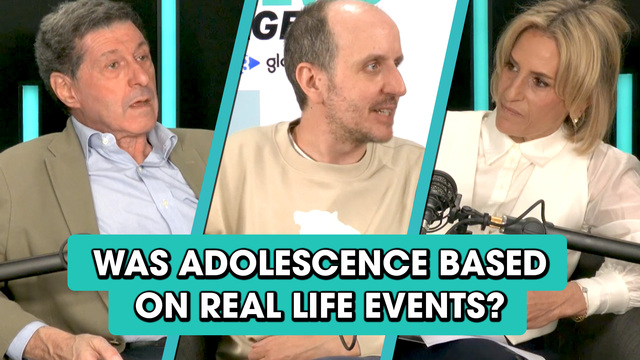
Was Adolescence based on real life events?
Will there be a second series?
The show has been a runaway hit.
The four-part drama, noteworthy, amongst other reasons, for each episode being filmed one continuous shot, has started a nationwide conversation - from social media all the way to the Commons - on what influences young boys in the modern age.
The story follows Jamie, a 13-year-old boy who stabs and kills Katie, a girl from his school.
It touches on themes of toxic masculinity, the manosphere and how the online world can influence young boys' behaviours and world-view.
“It's tapped into something quite primal, which is people's fears of what happens when teenagers' doors are closed,” Jack Thorne, the show's creator and writer tells The News Agents.
Fans of the show will be hoping for a second series - but if one comes, Thorne says don’t expect it to shed any more light on Jamie’s story.
“We would like to do another story with the one-shot template, perhaps, and we are thinking how we might be able to do that with Phil Barantini, our brilliant director.
“But no, I don't think it's about what happens next to Jamie. I think we've told that as fully as we possibly can.”
How does the manosphere play into it?
Actor Stephen Graham, who plays Jamie’s dad and co-wrote the series with Thorne, had “one stipulation” right from the start - not to rely on “tropes” that “blame the parents” for why a 13-year-old boy would commit such a heinous act.
“Things are a lot more complex than that,” Thorne says.
“We're not saying either that Jamie is a product of the manosphere. We're not saying that Jamie is the example of incel culture.
“What we're saying is that a huge number of factors – parents that didn't see him, a school that couldn't help him, friends that couldn't reach him, his own brain chemistry, and what he was able to access online – led to this.”
Whilst the show touches on Jamie’s online behaviour, the viewer never sees the specific content that Jamie has consumed - leaving some viewers wondering why an extra episode focussing on Jamie’s media consumption wasn’t included.
But this was intentional, Thorne says.
“If we'd spent an episode inside the manosphere, I think we might have been more easily dismissed.”
Thorne says that Adolescence was not an attempt to “answer every question” but rather to be a “partial look at something”.
“That encourages, I think, an audience to sit forward, to ask its own questions and do its own investigation, and think about it and talk about it in a way that is new to them.”
The story has hit a nerve with parents, who Emily Maitlis says used to worry about their kids going out at night - and are now worried about their kids staying in.
But the show was not intended to be a warning that all young boys across the country are “next”.
“I hope what we're not saying is, ‘there's Jamies all over the country’, because, of course, there aren't.
“But what there is all over the country is a lot of very confused boys, and a lot of boys that are saying or doing harmful things to girls because they have been polluted by what the internet can do.”
Andrew Tate - a name almost synonymous with the ‘manosphere’ - is mentioned in the series, but he’s not a focus.
“I don't think Andrew Tate was particularly taken seriously amongst kids, but by people who have taken on his message,” Thorne says.
He says the problem isn’t necessarily people such as Tate directly, but is instead the culture that surrounds masculinity, and the conversation that takes place when this turns “toxic”.
“We have to get out of toxic masculinity,” Thorn says.
“We also need to be trying to encourage young men to think of masculinity as a spectrum, and that's part of the problem with the manosphere, that it discourages people from saying it's okay to look different to other men.”
What Thorne hopes to see happen next
Since its release, Adolescence continues to be the most talked-about TV in the UK – drawing praise from critics and viewers, and criticism from terminally online people on social media.
The show’s timely storyline has even been discussed in the House of Commons, with Keir Starmer telling Parliament he had watched the show with his children.
And Thorne wants to see these conversations continue – and results in action to protect young people from following down the same path as Jamie.
He’s calling for a ban on smartphones in schools for under-16s, calling this a “necessity”, and saying he wants the government to act.
“We want to talk to the Prime Minister if we possibly can,” Thorne says.
Australia has already ended social media access for under-16s, and he wants the UK to follow suit.
“The other thing I think we should be thinking about, which is what the Australians are doing, is to try to remove our kids from social media,” he adds.
“They can still have phones, they can still communicate with each other, they can still have WhatsApp groups. They can still have games.
“But that idea of trying to prevent them being involved in these spaces, because these spaces create anxiety.”