Jamie Oliver’s new mission: ‘Schools failing a quarter of our children’
| Updated:

Jamie Oliver draws on his own experience of struggling with dyslexia to expose how Britain's education system is failing 25% of students with special needs, as the government promises once-in-a-generation reform.
Listen to this article
Read time: 4 minutes
In brief:
- Jamie Oliver, who was recently diagnosed with dyslexia and struggled in school, is now campaigning to reform support for students with special educational needs and disabilities (SEND), representing 25% of all students who are currently failed by the "one size fits all" education system.
- SEND students face long-term consequences including higher rates of mental health issues, suicide, and prison sentences, along with lower educational attainment and earning potential - yet teachers receive only half a day of SEND training during their three-year qualification.
- Education Secretary Bridget Phillipson acknowledges the system is failing and promises a schools white paper in Autumn that will address SEND support, funding reform, and teacher training, with Oliver involved in what she calls "a once in a generation opportunity" for change.
What’s the story?
Jamie Oliver is no stranger to taking on the education system.
The TV chef spent 20 years campaigning for healthier school dinners in British schools, fighting Turkey Twizzlers in canteens across the country.
But now, he’s taking on a more personal mission, as he attempts to reform the treatment and support for students with special educational needs and disabilities (SEND).
The cause is close to home for Oliver, who was recently diagnosed with dyslexia and felt outcast at school.
He becomes visibly emotional remembering his early years, and thinking of the 25% of students currently in the education system who have SEND.
“I ran away from school because I hated words and I hated what it represented, because I had nothing to offer it, and it was a big fingers-up to it as I ran off to cooking,” Oliver tells The News Agents.
He recalls teachers trying to “fix” his dyslexia by making him read Shakespeare to an assembly of 800 students, and was pulled from class as a teacher announced; ‘Can we have Jamie for special needs, please?”
While he says he remained resilient in response to the humiliation, he witnessed fellow classmates become shells of themselves.
“I don't want anyone to feel sorry for me, because there's nothing to feel sorry for, because I found a way. Lots don't find a way.”
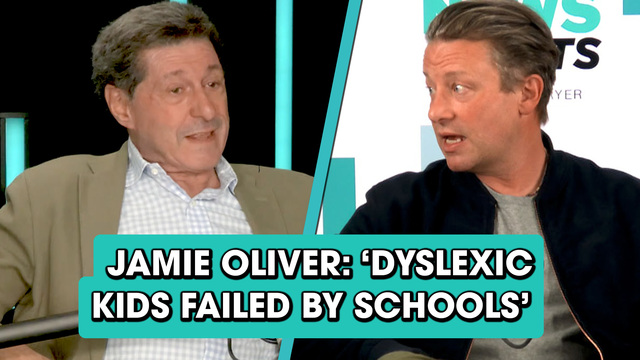
Jamie Oliver: 'Schools are failing dyslexic kids'
Why are schools failing SEND students?
Oliver believes the way children are taught in Britain’s education system is one-size-fits-all, when actually, “our brains are as different as our fingerprints.”
That one-size-fits-all system only caters to 75% of students, and the other 25% of SEND students get left behind.
“I just think it's primary school where the child is diminished, and I think that's really dangerous,” he adds.
The lack of support SEND students receive in schools are felt long after they leave.
“They're over-indexing in mental health problems, suicide, they’re a higher cost to the NHS, and over 55% of people in prisons are affected
“You earn less money on average if you're dyslexic or neurodiverse, and we don't have as good educational attainment and all the life chances that come with that,” Oliver says.
He argues what needs changing is the school's approach to teaching - not the child's approach to learning.
“Your child is the way nature intended,” is Oliver’s message to parents of SEND children.
He says while “the system might not be able to recognise that they're bright and brilliant” in traditional ways such as exemplary exam results, nature wanted to have “diverse thinkers” and “problem solvers”,
What needs to be done?
Oliver calls for two key reforms - improved teacher training in the latest science on the subject, and better screening of pupils to understand their needs.
In a recent Channel 4 documentary, Jamie's Dyslexia Revolution, one teacher revealed to OIiver that out of three years of teacher training only half a day was spent on training for SEND children.
“That’s four hours, essentially, to learn about what represents 25% of the class,” Oliver says.
In an effort to bring about change, the government will be launching a schools white paper in Autumn which will look at the support SEND children receive, funding reform, and teacher training and development.
Education secretary Bridget Phillipson tells Jon Sopel the Labour government is “determined” to make improvements to the system, admitting that at the moment the government is “not getting it right” and children are “not getting the support they need”.
Phillipson says the settlement to enforce change is “good” but “tight”.
“I do have to be upfront about that,” she says.
“We are going to have to work with schools to make this really, really work as part of a bigger reform program”.
Oliver will also be involved in the process of the white paper, something Phillipson calls “a once in a generation opportunity”.
“Those kinds of opportunities don't come around very often, so I'm acutely aware of the responsibility that I have to get that right.”
Listen to the latest episode of The News Agents.