Tina Brown: Journalism ‘titan’ on the ‘dark’ world of Donald Trump and his hate for the press
| Updated:

Tina Brown, who became the editor of Tatler magazine at 25, tells The News Agents about the evolution of journalism during her 50-year career and how the negative impact of Donald Trump and social media billionaires may have changed the industry forever.
Listen to this article
Read time: 6 mins
In brief…
- Tina Brown says Donald Trump has driven mistrust in journalism through a desire for “payback”, and describes him as existing in a “boiling sea of grudges” against what he sees as the liberal mainstream media.
- She adds that journalists are also in part to blame for a decline in trust in the industry, turning rage against Trump into clicks and falling for his “act” during his first presidency.
- The rise of social media and the tech billionaires has also driven this downturn, with Brown adding that the journalism industry can’t compete with the money and influence of people such as Elon Musk and Jeff Bezos.
The world of press and media was a different place when Tina Brown first made a name for herself.
And she made that name early – becoming the editor of Tatler magazine at 25, editor of Vanity Fair at 30 and editor of the New Yorker at 38.
Louis Goodall describes her as a “titan of journalism” and, now 71, the journalist, editor and author writes Fresh Hell on Substack, having followed the changes in her industry for close to 50 years – for better or worse.
“It was a moment when editors were being backed to do wonderful stories and only think about the content, which is such a luxury,” Brown tells The News Agents, speaking about her rise in the world of journalism.
“How many editors today can say they spend all their time worrying about fabulous pictures and stories and writers?
“They spend all their time thinking, ‘How do I exist? Where do I go with my tin cup to get a tiny bit of funding to keep 10 people around me?’”

Why the Democrats need a leader as 'entertaining' as Trump
Donald Trump ‘driven by desire for payback’ against mainstream media
Editing some of America’s most prestigious titles during the 1980s led to her first encounter with a young Donald Trump, a man she believes is partly responsible for the decline in journalism, and lack of trust in journalists, that hampers the industry today.
She describes Trump, in the process of building Trump Tower at the time, as “the ultimate symbol, essentially, of glitz in New York”.
A mean streak existed within Trump even then, she adds, recalling a charity dinner where he poured a glass of wine down the back of a female Vanity Fair journalist, before laughing about what he had done.
“He's a great communicator – there is just no doubt about it. He's also very funny when he wants to be,” she says.
“The difference now is how dark he's become. His rage and the unassuaged boiling sea of grudges in which he lives now is extraordinary.
“You just feel everything is about payback.”
And much of this drive for payback, Brown adds, is against the mainstream media, which he is so fond of calling “fake news”.
This, she believes, stems from the 2011 White House Correspondents Dinner, where Trump was roasted by Barack Obama, describing watching the back of Trump’s head turn from “a salmon colour to raging magenta”, as he felt the “liberal media” was laughing at him.
“Trump has been so effective at drilling into people's heads the idea that the mainstream media is biased and it's been very effective,” she says.
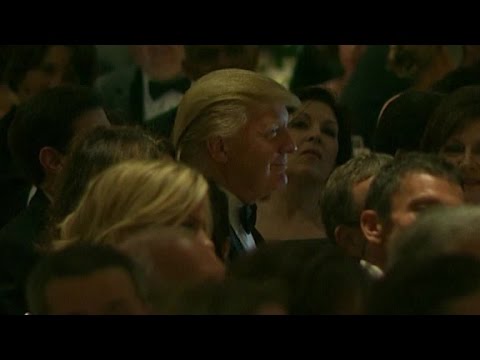
Watch Obama roast Trump
How journalists embraced the ‘Trump bump’ during his first presidency
In recent years, newspaper circulation has declined in the UK and US, news websites have closed down and more and more people have turned towards fringe publishers, often platforming extreme views and conspiracy theories – also favoured by Donald Trump.
But she says journalists must also shoulder some of the blame for this collapse, “falling for Trump’s act” during his first term as president because of the viewers and readership his unorthodox approach to presidency delivered.
She describes this as the “Trump bump”.
“It also had the effect of many news outlets thinking that the 'Trump bump' effect, of having all this kind of rage against him, was really so good for numbers that more and more it became these ranting heads on television.
“That has been a problem. I think Trump 2.0 journalism is doing much, much better. I think we have now become more alert to the act, more cynical of the act. Trump is being covered 24/7 – and frankly, he should be. He's changing the world, so he has to be covered.
“The President of the United States is always going to make news, and a lot of the stuff he's doing is consequential.”
Brown says Trump has upped his disdain for the mainstream media in his second term, removing “serious” journalists from the White House press pool, and replacing them with what she describes as “ridiculous influencer marginals from the extremes of MAGA.”
He is also involved in a $60 million (£45.2m) lawsuit against CBS and its parent company Paramount over an edited interview with Kamala Harris on its 60 Minutes news show, which aired during the 2024 presidential campaign.
“It is about harassing journalists with this constant threat of retribution,” Brown says.
“It's gotten to the point where foreign news outlets are telling their journalists when they enter the United States to bring burner phones with them.
“This is something quite different and much more worrying, and journalists are beginning to feel genuinely unsafe.”

Donald Trump ‘driven by desire for payback’ against mainstream media
Editing some of America’s most prestigious titles during the 1980s led to her first encounter with a young Donald Trump, a man she believes is partly responsible for the decline in journalism, and lack of trust in journalists, that hampers the industry today.
She describes Trump, in the process of building Trump Tower at the time, as “the ultimate symbol, essentially, of glitz in New York”.
A mean streak existed within Trump even then, she adds, recalling a charity dinner where he poured a glass of wine down the back of a female Vanity Fair journalist, before laughing about what he had done.
“He's a great communicator – there is just no doubt about it. He's also very funny when he wants to be,” she says.
“The difference now is how dark he's become. His rage and the unassuaged boiling sea of grudges in which he lives now is extraordinary.
“You just feel everything is about payback.”
And much of this drive for payback, Brown adds, is against the mainstream media, which he is so fond of calling “fake news”.
This, she believes, stems from the 2011 White House Correspondents Dinner, where Trump was roasted by Barack Obama, describing watching the back of Trump’s head turn from “a salmon colour to raging magenta”, as he felt the “liberal media” was laughing at him.
“Trump has been so effective at drilling into people's heads the idea that the mainstream media is biased and it's been very effective,” she says.
How social media and tech billionaires drove a decline in journalism
Of course, it’s not just Donald Trump who is re-shaping the journalism landscape – social media billionaires such as Elon Musk are also contributing to this enormous shift in trust, and truth.
Brown says he is among a “new crop of billionaires and media lusters”, who do not care about journalism or content.
“Musk just saw Twitter as a platform for his own very authoritarian ideology that he now has. He controls this mouthpiece, and he's using it relentlessly.
“The rest of them, I think, just have no interest in journalism. They don't understand journalism or value journalism, or truth.”
The journalism industry has negatively impacted due to the rise in social media, saying it was “supine” during the rise of Facebook, Twitter and Instagram, stemming from Silicon Valley, saying tech billionaires “stole all the content and monetised it for themselves.”
While this may have resulted in digital traffic to news websites, she says this essentially led to a collapse of the industry.
She believes it is more prepared for the AI revolution, but believes journalists and publications are fighting a losing battle against the wealth, power and influence of the tech giants.
“Ultimately, Silicon Valley will always win in this because they have the massive money and massive numbers,” she says.
“The collapse of the business model, of course, meant that the influx of trash and people publishing lies rose intensely.
“It has, of course, also allowed some brilliant new platforms to start, so there is an upside to it, but unfortunately, the impact on truth has been very deleterious.”
The opportunities presented by today’s journalism landscape
Despite all this, and a lack of opportunities for young journalists hoping to break into the industry in 2025, Brown believes there is potential in the new media landscape, which she has embraced with Fresh Hell, offering “absolutely free thinking” to those looking to carve a career.
She says she now enjoys the intimacy of self-publishing, and having a closer relationship with – and understanding of – the people reading her work.
“Young journalists today have to be much more enterprising about making their own luck,” she says.
“if you can't find something to work on, you've got to start your own.
“Journalism gives you a wonderful way to ask really inappropriate questions and get the answers.”
Listen to the latest episode of The News Agents.